AI Code Generation: Write Programs 75% Faster with New AI Tools

Advertisements
AI code generation is transforming software development, allowing developers to write programs significantly faster. New AI tools automate routine tasks, suggest code, and even debug, leading to a remarkable increase in efficiency and innovation across the industry.
The landscape of software development is undergoing a dramatic transformation, driven by the emergence of powerful artificial intelligence. In an era where speed and efficiency are paramount, AI code generation tools are not just a luxury but a necessity, empowering developers to write programs up to 75% faster. This revolutionary shift promises to redefine productivity and innovation in the tech world.
The Dawn of AI in Software Development
The integration of artificial intelligence into software development workflows marks a pivotal moment, moving beyond simple automation to genuine co-creation. AI is no longer just a tool for data analysis or machine learning models; it has become an active participant in the coding process itself. This evolution is fundamentally changing how developers approach problem-solving and project execution, pushing the boundaries of what’s possible.
Understanding AI-Powered Code Generation
At its core, AI code generation involves using machine learning models to automatically produce source code. These models are trained on vast datasets of existing code, allowing them to learn patterns, syntax, and best practices. When given a prompt or a high-level description, they can generate functional code snippets, functions, or even entire program structures. This capability drastically reduces the manual effort traditionally required in coding.
- Predictive Text for Code: Similar to how smartphones suggest words, AI coding assistants predict and suggest code as you type, completing lines or blocks of code.
- Automated Boilerplate Generation: AI can quickly generate repetitive code structures, such as class definitions, API calls, or database schemas, freeing developers from tedious tasks.
- Code Refactoring Suggestions: Advanced AI tools can analyze existing code and propose improvements for efficiency, readability, and adherence to coding standards.
- Natural Language to Code: Some cutting-edge AI allows developers to describe desired functionality in plain English, and the AI translates it into executable code.
The impact of these tools is multifaceted, extending beyond mere speed. They enhance code quality by suggesting optimized solutions, reduce the likelihood of human error, and enable developers to focus on higher-level architectural design and complex problem-solving rather than getting bogged down in syntax and boilerplate. This shift not only accelerates development cycles but also elevates the role of the developer to a more strategic position.
How AI Boosts Coding Efficiency by Up to 75%
The claim of writing programs 75% faster might seem ambitious, but it’s grounded in the real-world performance gains observed with modern AI code generation tools. This significant acceleration stems from several key areas where AI excels, fundamentally altering the developer’s daily routine and project timelines.
One of the primary drivers of this efficiency is the automation of repetitive and mundane tasks. Developers spend a considerable amount of time writing boilerplate code, setting up environments, or implementing standard data structures. AI tools can handle these tasks in seconds, effectively compressing hours of work into minutes. This immediate time-saving alone contributes substantially to the overall speed increase.
Streamlining the Development Workflow
AI integrates seamlessly into various stages of the software development lifecycle, optimizing each step. From initial conceptualization to deployment and maintenance, AI offers support that makes the process smoother and faster.
- Rapid Prototyping: AI can quickly generate initial codebases or functional prototypes based on high-level specifications, allowing teams to validate ideas much faster.
- Error Reduction: By suggesting correct syntax, spotting potential bugs, and even offering fixes in real-time, AI significantly reduces the time spent on debugging.
- Contextual Code Suggestions: Beyond simple auto-completion, AI understands the surrounding code and provides contextually relevant suggestions, improving both speed and accuracy.
- Automated Testing: Some AI tools can even generate unit tests or test cases, ensuring code quality and reducing the manual effort in quality assurance.
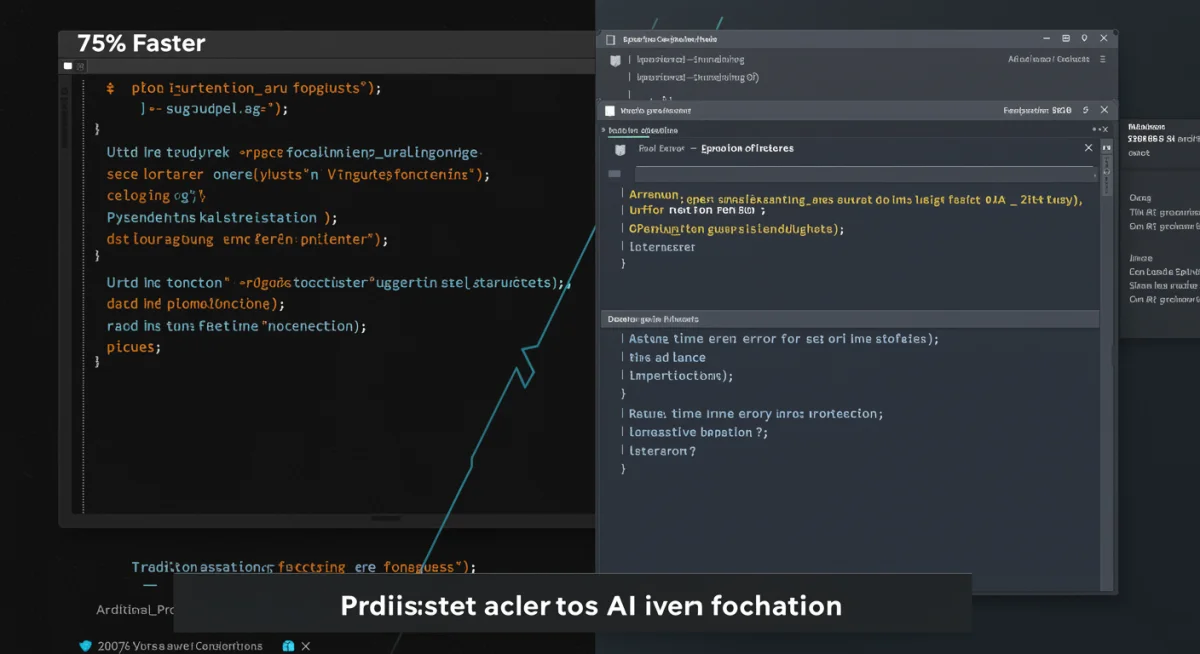
Consider a developer tasked with building a new feature. Instead of manually writing every line, they can leverage AI to generate the basic structure, fill in common data handling logic, and even suggest optimal algorithms. This allows the developer to concentrate on the unique business logic and creative aspects of the feature, rather than the mechanical act of typing code. The cumulative effect of these optimizations across an entire project can easily lead to the reported 75% increase in development velocity.
Key AI Tools Revolutionizing Code Generation
The market for AI code generation tools is rapidly expanding, with several prominent players leading the charge. These tools vary in their capabilities, integration options, and target audiences, but all share the common goal of making coding faster and more efficient. Understanding the landscape of these tools is crucial for any developer looking to harness the power of AI.
From IDE integrations to standalone platforms, these tools are designed to assist developers at various stages of their work. They often employ sophisticated large language models (LLMs) trained on billions of lines of code, enabling them to generate highly relevant and functional code snippets in multiple programming languages.
Leading AI Code Assistants and Platforms
The following tools exemplify the current state-of-the-art in AI code generation, each offering unique strengths that cater to different development needs.
- GitHub Copilot: Developed by GitHub and OpenAI, Copilot is perhaps the most well-known AI coding assistant. It integrates directly into popular IDEs like VS Code and provides real-time code suggestions, function completions, and even entire method implementations based on comments or existing code.
- Tabnine: An AI code completion tool that offers highly accurate and context-aware suggestions. Tabnine learns from your code patterns and provides personalized completions, supporting a wide range of programming languages and IDEs. It can run locally, ensuring data privacy for sensitive projects.
- CodeWhisperer (Amazon): Amazon’s entry into the AI coding assistant space, CodeWhisperer, focuses on enterprise developers, offering code suggestions for various languages and services, particularly those within the AWS ecosystem. It also includes security scanning features to identify potential vulnerabilities.
- ChatGPT/GPT-4 for Coding: While not exclusively a code generation tool, OpenAI’s powerful language models can be prompted to write code, debug, explain complex concepts, and even generate entire project structures. Developers often use it as an intelligent pair programmer for brainstorming and rapid prototyping.
- Replit AI: Integrated into the Replit online IDE, Replit AI provides code completion, generation, and debugging assistance, making it particularly useful for rapid development and collaborative coding environments.
Each of these tools represents a significant leap forward in developer productivity. They not only accelerate the coding process but also serve as valuable learning aids, exposing developers to new patterns and optimal solutions. The choice of tool often depends on individual preferences, project requirements, and the specific programming languages and environments in use.
Practical Applications and Use Cases
The theoretical benefits of AI code generation translate into tangible advantages across a multitude of practical scenarios in software development. From accelerating initial project setup to enhancing the maintainability of existing systems, AI tools are proving their worth in diverse applications.
Developers are leveraging AI to automate tasks that were once time-consuming and prone to human error, allowing them to redirect their focus to more complex and creative challenges. This strategic reallocation of effort not only speeds up development but also fosters innovation.
Transforming Daily Developer Tasks
AI code generation is not just for greenfield projects; it profoundly impacts everyday coding activities:
- API Integration: Generating boilerplate code for API calls, data serialization, and error handling, significantly reducing the effort to connect different services.
- Database Interactions: Creating SQL queries, ORM models, and database migration scripts based on schema definitions or natural language descriptions.
- Frontend Component Generation: Developing UI components, styling, and basic interactivity for web and mobile applications with minimal manual coding.
- Scripting and Automation: Writing utility scripts for system administration, data processing, or deployment automation faster and with fewer errors.
- Legacy Code Modernization: Assisting in refactoring old codebases, suggesting modern equivalents for outdated functions, or generating tests for existing code.
Consider a scenario where a developer needs to implement a new data validation layer. Instead of writing all the validation rules manually, an AI tool can generate the foundational structure and common validation checks based on the data model. The developer then only needs to fine-tune specific business rules, dramatically cutting down development time. Similarly, for building out a new microservice, AI can scaffold the entire service, including routing, data models, and basic business logic, providing a robust starting point that would otherwise take days to construct manually. These real-world applications underscore the transformative power of AI in accelerating software delivery.
Challenges and Considerations in AI Code Generation
While the benefits of AI code generation are undeniable, it’s essential to approach its adoption with a clear understanding of the challenges and considerations involved. Like any powerful technology, AI coding tools come with their own set of complexities that require careful management to ensure optimal outcomes.
The promise of speed must be balanced against concerns regarding code quality, security, and the evolving role of human developers. Addressing these issues proactively is key to successful integration of AI into development workflows.
Navigating the Complexities of AI-Assisted Coding
- Code Quality and Maintainability: AI-generated code, while functional, may not always adhere to specific coding standards or best practices of a particular team. It might also be less optimized or harder to maintain if not properly reviewed and refined by human developers.
- Security Vulnerabilities: If AI models are trained on insecure code or generate code without proper security considerations, they could introduce vulnerabilities into applications. Rigorous security scanning and developer oversight remain crucial.
- Intellectual Property and Licensing: The origin of AI-generated code, especially when trained on vast public repositories, raises questions about intellectual property rights and licensing compliance. Developers need to be aware of the implications.
- Over-reliance and Skill Erosion: An excessive dependence on AI for basic coding tasks could potentially lead to a decline in fundamental coding skills among developers. It’s important to view AI as an assistant, not a replacement for human expertise.
- Contextual Limitations: While AI is good at generating common patterns, it may struggle with highly specific, novel, or deeply contextual business logic that requires nuanced human understanding.
To mitigate these challenges, organizations should implement robust code review processes for AI-generated code, educate developers on best practices for using these tools responsibly, and stay informed about evolving legal and ethical guidelines. The goal is to leverage AI’s strengths while actively addressing its limitations, ensuring that the technology serves to augment human capabilities rather than diminish them. A balanced approach will maximize the efficiency gains while maintaining high standards of code quality and security.
The Future Landscape of Programming with AI
The trajectory of AI in software development points towards an increasingly integrated and symbiotic relationship between human developers and intelligent systems. The current rapid advancements in large language models and machine learning suggest that the capabilities of AI code generation will only continue to grow, leading to profound shifts in how software is conceived, built, and maintained.
We are moving towards a future where the act of programming becomes less about writing individual lines of code and more about architecting, guiding, and refining the output of sophisticated AI systems. This evolution demands new skill sets and a redefined understanding of the developer’s role.
Evolving Roles and Emerging Technologies
As AI tools become more sophisticated, several trends are likely to shape the future of programming:
- Increased Focus on High-Level Design: Developers will spend more time on system architecture, problem definition, and strategic planning, offloading much of the implementation detail to AI.
- Prompt Engineering as a Core Skill: The ability to effectively communicate requirements to AI models through natural language prompts will become a critical skill, akin to current programming languages.
- AI for Code Review and Optimization: AI will play a larger role in automated code reviews, identifying performance bottlenecks, security flaws, and suggesting complex optimizations that are difficult for humans to spot.
- Personalized AI Assistants: Future AI tools will be even more tailored to individual developer preferences, project contexts, and team coding standards, offering highly personalized assistance.
- Low-Code/No-Code Platforms Enhanced by AI: AI will further empower low-code and no-code platforms, allowing non-developers to create complex applications through intuitive interfaces and AI-driven generation.
The vision is not one where AI replaces developers entirely, but rather one where AI acts as an incredibly powerful force multiplier. Developers will become orchestrators of AI, guiding it to build complex systems, while focusing their own expertise on innovation, critical thinking, and ensuring the human-centric aspects of software. This collaborative future promises to unlock unprecedented levels of productivity and creativity, making software development more accessible and powerful than ever before.
Integrating AI into Your Development Workflow
For individuals and organizations looking to capitalize on the benefits of AI code generation, strategic integration into existing development workflows is paramount. It’s not simply about adopting a new tool, but about thoughtfully incorporating AI to complement human expertise and optimize processes without disrupting established practices.
A phased approach, coupled with continuous learning and adaptation, will ensure that AI tools genuinely enhance productivity rather than creating new bottlenecks or complexities. The goal is to create a harmonious ecosystem where human and artificial intelligence collaborate effectively.
Best Practices for Adopting AI Code Generation Tools
Successfully integrating AI into your workflow requires a structured approach:
- Start Small and Experiment: Begin by experimenting with AI tools on less critical tasks or side projects to understand their capabilities and limitations without impacting core development.
- Educate Your Team: Provide training and resources to help developers understand how to effectively use AI tools, including best practices for prompting, reviewing AI-generated code, and understanding its output.
- Establish Clear Guidelines: Develop internal guidelines for using AI-generated code, including standards for review, testing, security checks, and adherence to licensing agreements.
- Maintain Human Oversight: Emphasize that AI is an assistant. All AI-generated code must be thoroughly reviewed, tested, and understood by a human developer before being integrated into production systems.
- Monitor Performance and Feedback: Continuously monitor the impact of AI tools on productivity, code quality, and developer satisfaction. Gather feedback to refine integration strategies and identify areas for improvement.
- Choose the Right Tools: Select AI tools that align with your team’s programming languages, IDEs, project types, and security requirements. Consider factors like local vs. cloud-based processing for data privacy.
By following these best practices, teams can smoothly transition to an AI-augmented development environment, unlocking the potential for significantly faster program writing and enhanced overall efficiency. The integration of AI should be seen as an ongoing process of learning and refinement, allowing developers to evolve alongside the technology and continuously improve their craft. This thoughtful adoption will ensure that AI code generation becomes a powerful asset in any modern development toolkit.
| Key Aspect | Brief Description |
|---|---|
| Efficiency Gains | AI tools accelerate coding by automating boilerplate, suggesting code, and reducing debugging time, leading to up to 75% faster program writing. |
| Core Functionality | AI code generation uses machine learning to produce functional code snippets, translate natural language to code, and provide context-aware suggestions. |
| Leading Tools | Key tools include GitHub Copilot, Tabnine, Amazon CodeWhisperer, and general-purpose LLMs like ChatGPT, each with unique features. |
| Challenges | Concerns include code quality, security vulnerabilities, intellectual property, and the potential for over-reliance, requiring careful human oversight. |
Frequently Asked Questions About AI Code Generation
AI code generation involves using artificial intelligence, typically machine learning models trained on vast code datasets, to automatically produce source code. These tools can suggest code snippets, complete functions, or even generate entire program structures based on developer prompts or existing context, significantly speeding up development.
AI achieves this by automating repetitive tasks, generating boilerplate code, providing real-time contextual suggestions, and helping identify and fix errors quickly. By reducing manual coding effort and speeding up debugging, developers can focus on higher-level logic, leading to substantial overall efficiency gains across projects.
While AI-generated code is often functional, it’s not always guaranteed to be perfectly reliable or secure. It can sometimes contain bugs, inefficiencies, or even security vulnerabilities if the AI model was trained on flawed data. Human review, testing, and security scanning remain crucial steps to ensure code quality and safety.
No, AI code generation is unlikely to replace human developers entirely. Instead, it acts as a powerful assistant, augmenting developer capabilities and automating mundane tasks. Developers will shift their focus towards high-level design, critical thinking, problem-solving, and refining AI-generated code, evolving into ‘AI orchestrators’ rather than being replaced.
Developers should focus on skills like prompt engineering (effectively communicating with AI), critical evaluation of AI-generated code, system architecture, complex problem-solving, and understanding security implications. Adaptability and continuous learning about new AI tools and best practices will also be vital for future success.
Conclusion
The advent of AI code generation tools marks a transformative era for software development, offering unprecedented opportunities for increased efficiency and innovation. By automating repetitive tasks, suggesting intelligent code completions, and aiding in debugging, these tools demonstrably enable developers to write programs significantly faster, potentially by as much as 75%. While challenges related to code quality, security, and intellectual property necessitate careful human oversight and strategic integration, the future of programming is undeniably collaborative. Developers are poised to evolve into architects and orchestrators of AI, leveraging these powerful tools to focus on higher-level problem-solving and creative endeavors, ultimately driving the industry forward at an accelerated pace.
Related Posts: